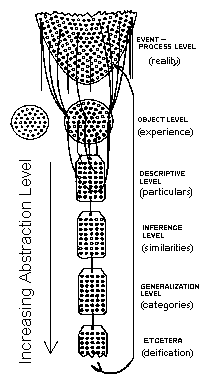
The Structural Differential offers a system to think in a sane manner. The following paper was written in regards to this system and an application in art. 
This paper is a an attempt to look at 'Art', the process of creating 'Art' and the 'Theories of Criticizing Art' within a different framework than the norm. The new theory and framework used is based off of the book 'Science and Sanity' written by Alfred H. Korzibski. To achieve this goal, we must first take a good hard look at this new linguistic structure, its theory and its practice. From there we will be able to refer back to 'Art ' with a deferent frame of mind.
KORZIBSKI'S THEORY
"General Semantics is not any 'philosophy', or 'psychology', or 'logic', in the ordinary sense. It is a new extensional discipline which explains and trains us how to use our nervous systems most efficiently. It is not a medical science, but like bacteriology, it is indispensable for medicine in general, and for psychiatry, mental hygiene, and education in particular. In brief, it is the formulation of a new non-aristotilian system of orientation which affects every branch of science and life. The separate issues involved are not entirely new; their methodological formulation as a system which is workable, teachable and so elementary that it can be applied by children, is entirely new."
From the cover of 'Science and Sanity' by Alfred Korzybski.1
~~~~~~~~~~~~~~~~~~~~~~~~~~~~~~~~~~~
Our current form of thinking has been highly associated with Aristotle and is therefore called 'Aristotilian' thinking which is based on the 'is' of identity, that is; A is A (an object is what it IS), or A is not A, or an object cannot be both A and not A. This process of identification is false to facts and proven to be wrong. For example, in this form of thinking, we say and identify the item called a 'pencil' as a 'writing instrument'. Therefore, A is A. This leaves no room for its other features, such as 'an erasing instrument', 'hair tie', 'back scratcher', etc. Seeing that this thinking process and linguistic structure is false to facts is a monumental discovery, a discovery that mathematicians and scientists have long since discovered and, as a result, have created a language that is true to facts. This realization, that everything has multi-ordinal functions, has lead to a need to re-structure our semantics to be in accord with reality. By doing so, we are enlarging our circle of knowledge to a 'Non-Aristotilan' concept which encompasses but expands upon our current Aristotilian language.
Korzybski has created a model in which to understand and process this new non-Aristotilan concept called The Structural Differential which will be explained later. First we are going to go through an example that will help bring us to the understanding of the theory and model. To do so, I asked my tow kids to tell me 'all' about the painting we call "Starry Nights'. I wouldn't stop asking for more information until they realized and agreed that this was an impossible task.
Following is a description of the image made by Van Gogh called 'Starry Nights':

2
"sun, moon, blue, wind, mountains, ocean, fire, town, tower, bright dots, green in it, warm feeling, yellow, grey/blue mountains, brown, waves, orange, rocks, sea urchins, black, red, white, farm, houses, church, paint brush dashes, circles, half circle, swirls, wood, metal, roof tops, doors, lights on, quiet town, no people seen, lots of windows, trees, rock formations, street, tan, windy and cold and cloudless night, painting, frame, designs on frame, square shaped, gold frame, purple, outlines with in frame, white waves, light and dark, stars, 20 corners, designs in layers on frame, a mine, lines, straight edges, polka dots, smooth edge on frame, can see edge of painting, air, dark lines, there are lines to the corners, canvas, paint, colors, can be moved, can be smashed, touched, there is a butt in it, 3 dimensions, can see it, can be understood, can break, can be hung up, expensive, old, why is it here?, painted by Van Gogh, textures, front side, back side, there is an up and a down, ground, light shining on it so we can see, picture, hung in famous museum, in New York, the wood on back, electrons different sizes for different angles, atoms, shadow,"
In the above description, I asked my kids to tell me "all" about the image. They were feeling pretty satisfied around the time that they described swirls, which, as we can see is very early in our list. I kept pushing them to tell me more about it, I wanted to know 'all' about it. After coming to the end of our descriptions we never even got to the tiny description that is tagged with the painting, giving the so called details of it, such as:
Vincent van Gogh. (Dutch, 1853-1890). The Starry Night. Saint Rémy, June 1889. Oil on canvas, 29 x 36 1/4" (73.7 x 92.1 cm). As a reader we can realize that there is so much more that can be said about this event we call 'Starry Nights'.3
After some time, the children became convinced that we can not identify the allness of an object. Hence we then learn to also disregard the 'is' of identity, which is very important for our proper semantic understanding. The process of the 'is' of identity is the process used by animals and infants, which is natural for them and for older civilizations, but not so for our current evolvement. The fundamentals are discussed quite well by Ralph E. Kenyon in his paper "What is General Semantics" published in 1983. He states: "If general semantics is a new paradigm, then what is its most significant structure? How can general semantics best be characterized? What is fundamental to this new paradigm? Two things provide the base. The first of these is the method by which the human entity receives and processes information, from the non-verbal sensing thru and including the highly verbal thinking and talking. The other basis is the methods of science, including the way knowledge grows and the process of revising theories.
In summarizing the first process, general semantics emphasizes the abstracting of information (selecting some and discarding the rest), transducing that information (for example, changing from the physical vibrations of sound in air to the electro-chemical impulses in nerves) and the "model" or "map" character of the information. As we process information (perceptions, words, etc.), we convert the raw data into our own internal form of representation (models). In the conversion process, we fit the information into our pre-conceived notions and develop hypotheses to account for the data. A similar process (forming hypotheses, or building models) happens even at the most nonverbal levels of nervous system processing. General semantics regards this characteristic "model-making" structure of our nervous systems as fundamentally important and implies that an awareness of this process must be considered in our daily activities as well as in the organizing philosophy of our world view.
Secondly, the study of Science reveals that growth of scientific knowledge and theory follows a pattern similar to the method by which the human entity receives and processes information. Information is collected, some kept and some discarded, and attempted to be fit into the current scientific theories (models). Information which doesn't fit is used to construct a new theory and a test is devised to check out the new theory (model, hypothesis, etc.). New theories can replace old, be discarded, or be neither confirmed nor denied."4
5 The Structural Differential model is used to understand the 'orders of abstraction' which is a (not 'the') proper way to think and speak. We use the above description of the event 'Starry Nights' and plug it into this model. The event or process is represented by the top section of this model. The top of this section is torn off to imply that there is more than we can see or understand, the 'unknowns' of the event. Here we are referring to the sub-micrscopic level and what we infer is going on. The strings connected to the Objective level represent that which we experience with our senses, while the non-connecting strings represent those we do not experience, such as radio waves, etc.
The Objective level represents the object and our interaction with this object through our nervous system and senses. The free hanging strings represent the characteristics that were left out of our descriptions of the event. They are not connected to the Descriptive level. This is where the children realized they could not fully realize and describe 'all' about the painting. These strings represent our experience on a non-verbal level, that un-speakable level that is experienced before we try to tag it with labels.
The next order of abstraction occurs on the Descriptive level. This is where the verbal aspect first enters the abstraction process. Those aspects that we experienced and recognized on the objective level are now abstracted to the verbal "Descriptive" level we refer to as 'labels'. The strings that do not connect from the O level to the D level are those that we may have discarded. Here we try to stay as 'true to facts' as possible.
In the order of abstracting, the next process is the label termed 'Inference'. This is our theories, judgements, beliefs, etc. At this level we can draw from our past experiences. Still there are holes that are not tapped into, to represent those aspects of the particular event not consciously being recognized. There are many levels of Inferences which continue on and are represented in this model by the many tags I1, I2, I3, etc. The bottom tag being torn, as the top section is, to infer the many 'events' not consciously being brought to mind for the current event that we are abstracting from.
As we can see from the above referenced experiment of description with the kids, these two levels of Descriptive-true to facts and the Inference levels, were not differentiated between. They used terms such as "windy"," cold","there is a butt", "quiet", "warm feeling" etc. Now we have a proof that the orders of abstraction are not realized and are getting jumbled up in the Aristolian process of 'thinking'. This form of attempted processing and linguistic expression has caused a jumbled and confused process that effects the nervous system in a reversed manner and is causing semantic disturbances within the mind-body of the thinker. The abstraction process of 'Descriptive' and 'personal Inferences' has been confused as being one process.
The A arrow refers back to the event and suggests 'time'. We are taking our different abstracted thoughts and brought them 'back' to the event. Then we can use this information for the next 'time' that it would be useful. For example, if I were to ask the children to describe an object they would most likely use this 'time-binding' capability of humans, and refer back to their first experience of this experiment and not have the same preconceived ideas that they had on the first go around. Therefore, every event would have a different model because these events all happen through the aspect referred to as 'time'.6
In Steve Stackdales discussion of the Structural Differential he states: "I think it's important to remember how 'time', or order, sequence, etc., plays into this model. Each level of the abstracting occurs in a given order, i.e.:
1. Something happens (Event);
2. I sense what happens (Object);
3. I recognize what happens (Description);
4. I generate meanings for what happens; etc. (Inferences)
In terms of differentiation, we 'should' note that
1. What happens (Event) is NOT ...
2. What I sense non-verbally within my nervous system (Object), which is NOT ...
3. What I can describe verbally about my sensing (Description), which is NOT ...
4. The meaning(s) I generate based on what happened; etc. (Inferences)
Similarly, our experience/inference/meaning at Time4 is NOT the 'same'
experience/inference/meaning at Time1."7
Notice that this model of abstraction takes in the 'organism-as-a-whole' incorporating body, mind and emotions and not trying to make the mistake of separating these aspects that can not be realistically separated.
So now we come to the question of application. Here we will use this opportunity of application in reference to the process we call 'Art' and 'Theories of Art'. Language is a system of symbols that we agree upon and use accordingly. Richard Clarke states in his paper on General Semantics and Art Education: "The only connection between sym- bols and the nonverbal level that is represented appears to be structural. That is, the nonverbal may be sym- bolized only through some similarity, in order or relations (as map and ter- ritory), between it and the symbol. This relation of symbols to the non- verbal world, rather than the man- ipulation of symbols, should be taught. Students should know that ab- stracting plays a fundamental part in all experience and that art processes appear as processes of abstracting."8 Using this way of thinking, while thinking about a particular art piece, helps to